
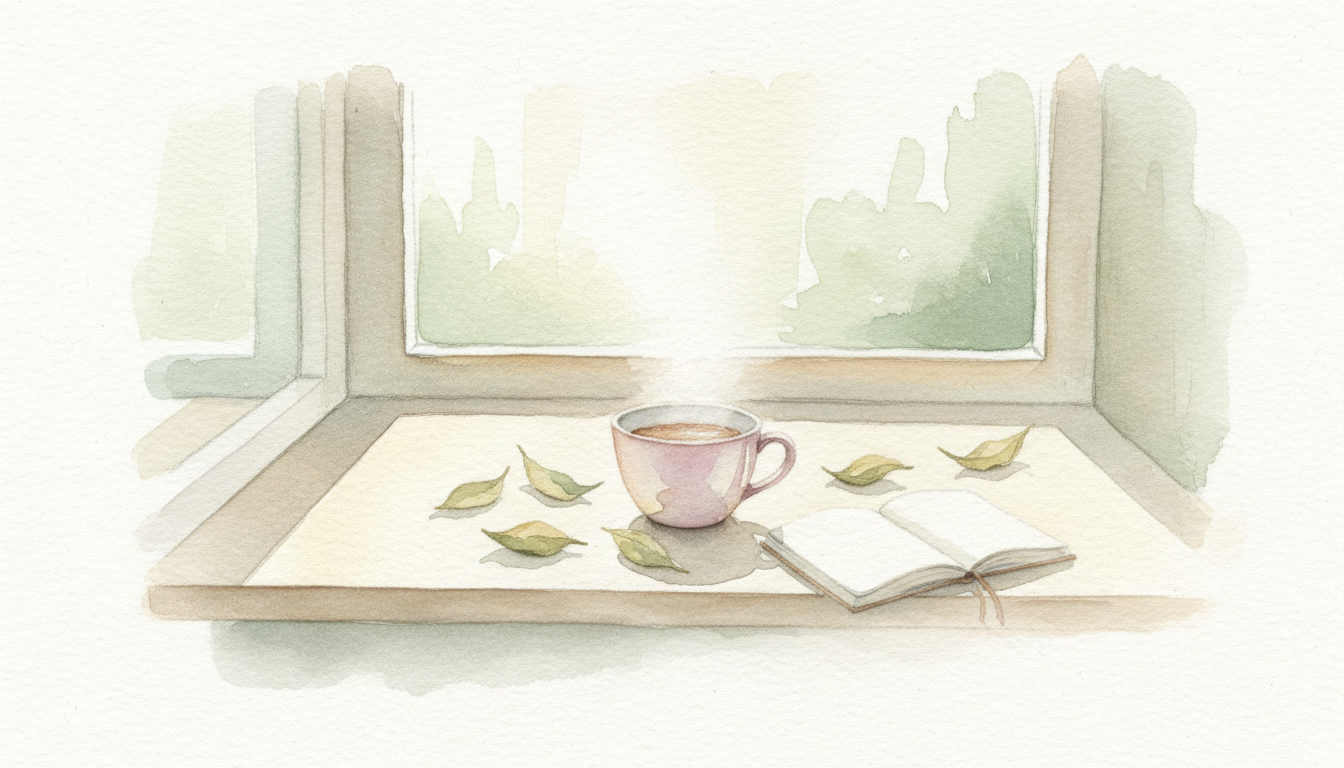
You sit down to journal, ready to be honest with yourself, and your mind goes completely flat. “How am I feeling?” you ask — and the answer is a shrug. The cursor blinks. The page stays blank, and after a minute you close it.
This happens to almost everyone. The problem usually isn’t that you have nothing to say. It’s that you reached for the biggest question first.
Start with the concrete, not the deep
When you don’t know what to write, don’t write about your feelings. Write about the room.
Describe what’s actually in front of you. The half-finished cup of tea. The light coming through the window. The sock on the floor you keep meaning to pick up. You’re not trying to be profound — you’re just getting your hand moving and your attention into the moment.
Here’s the quiet trick: the feelings are hiding inside the details. The cold tea is there because you got absorbed in something, or you forgot, or you’ve been too restless to sit still. You’ll often find that by the third or fourth concrete sentence, you’ve drifted — without trying — into what’s actually on your mind.
A thirty-second version
If you only have a moment, try this:
- Name one thing you can see.
- Name one thing you can hear.
- Name one thing your body feels right now — tired, tense, warm, hungry.
That’s three short lines, and it’s a complete entry. You grounded yourself in a specific moment of your actual life, which is more than most journaling sessions manage. 🌿
The blank page feels like a test you have to pass with something meaningful. It isn’t. It’s just a place to set down what’s true right now, starting with the smallest, most ordinary thing you can see.
So the next time your mind goes flat, don’t push for depth. Look up, pick one real detail, and describe it. The door opens from there.