Most journaling points at the present. You write to sort out the day you just had, the thing that’s circling, the mood you can’t name. The reader you’re writing for is, quietly, yourself tonight.
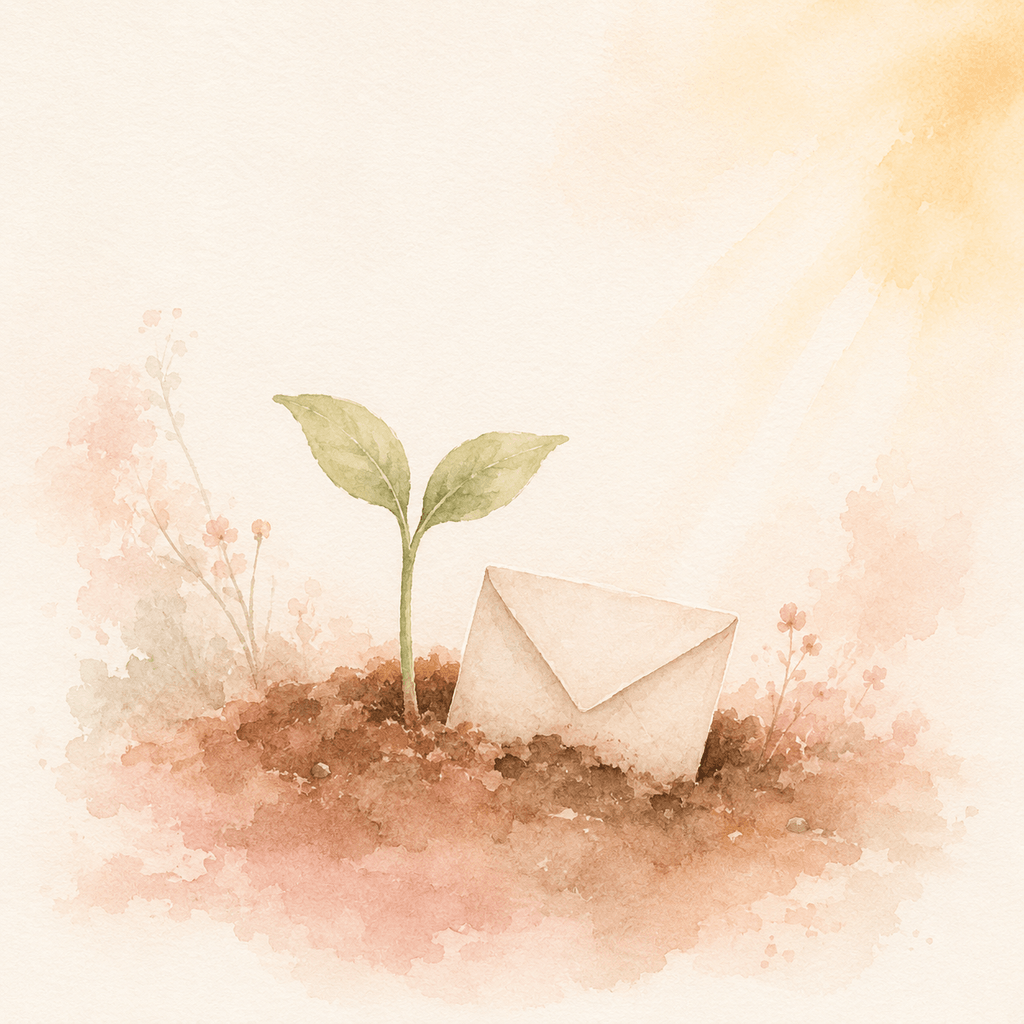
A time capsule turns that around. You write to a version of you that doesn’t exist yet — six months out, a year, ten — and then you seal it. You don’t get to keep editing it. You don’t even get to peek. You just plant it and walk away, and one day it opens on its own.
You can’t perform for someone you can’t picture
When you write for tonight, you know your audience a little too well. It’s easy to tidy the entry, to land on the neat conclusion, to write the version of the day you’d want to remember.
Writing forward breaks that habit. You have no idea who’s going to open this. You don’t know what they’ll be worried about, what will have worked out, what they’ll have completely forgotten. So you stop performing and just tell them the truth of where you are: what you’re hoping for, what you’re scared of, what today actually felt like. A sealed letter is honest in a way a normal entry rarely manages, precisely because you can’t go back and clean it up.
The wait is the whole point
The reason it lands is that you can’t open it early. By the time it does, you’re genuinely a different person reading a stranger’s note — and the gap between who wrote it and who reads it is where all the feeling lives.
In slowbloom you pick how long that gap is by choosing a plant: a daisy opens in two months, a rose in a year, a cherry blossom in ten. It grows quietly in your garden the whole time, counting down, sealed and end-to-end encrypted so no one can read it — not even you, until the day it blooms. Then it surfaces on its own and lets you know it’s ready.
It’s worth being a little deliberate about what you send forward:
- A hope you’re almost embarrassed to say out loud, so the future you knows you dared to want it.
- A snapshot of an ordinary day — the small details memory always drops.
- A worry that feels permanent right now, addressed to someone who’ll know how it turned out.
- A question. “Are you still doing this? Did it get better? Was it worth it?”
That last one is the quiet magic of it. You’re not just leaving a note — you’re starting a conversation with someone who can’t answer yet, but will.
Plant one today
You don’t need a milestone or the perfect words. Open slowbloom, plant a seed, and write to whoever you’ll be when it opens. Tell them where you are right now, honestly, while you still can’t see how the story ends.
Then seal it, and let it grow. The next time you hear from it, you’ll be the one it was written for — meeting a version of yourself you’d half forgotten, who took a minute, once, to write you something true.